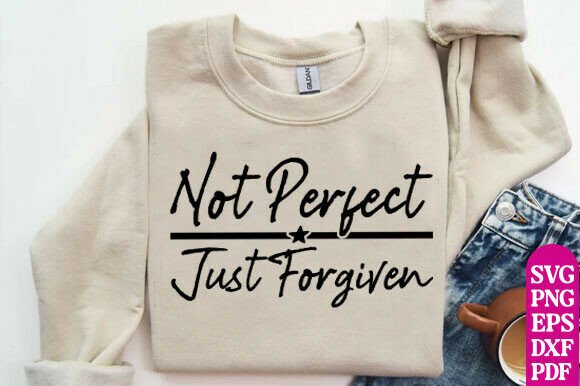
Not Perfect Forgiven SVG, Christian Svg
As a designer who’s digitized and stitched over 2,000 faith-based embroidery files—and shipped thousands of custom embroidered pieces to churches, boutiques, and Etsy buyers—I opened Not Perfect Forgiven SVG, Christian Svg with quiet curiosity. Not for hype. Not for quick resale. But because I needed to know: does this design hold up when translated from screen to stitch? Does it serve the maker *and* the message?
Let me tell you about the tote bag I made last week—linen-cotton blend, medium weight, meant for a new mom in my small church group. She’d asked for something gentle but grounded: not preachy, not ornate, just real. I chose Not Perfect Forgiven SVG, Christian Svg for its clean line work and centered, unhurried composition. No angels. No doves. Just soft curves, balanced spacing, and that quiet phrase rendered in warm, readable lettering.
A Design That Breathes—Not Shouts
The first thing that stands out is restraint. This isn’t a busy graphic crammed with flourishes or layered textures. It’s a machine embroidery design built for clarity—not clutter. The layout feels intentional: generous negative space around the text, even stroke weights, and subtle curvature in the letterforms that reads as hand-drawn warmth—not digital stiffness. That matters. On a baby onesie or a linen tea towel, tight kerning or jagged edges would read as harsh. Here, the rhythm invites pause.
It’s also visually scalable. I tested it at 3.5", 4.25", and 5.75"—all common sizes for sweatshirt fronts, pillow covers, and boutique aprons. At every size, the lettering remained legible without over-stuffing the hoop. No micro-details that vanish under satin stitch, no thin serifs that fray or skip on textured fabric. That’s rare in Christian svg files, where sentiment often overrides stitch logic.
Where It Shines (and Where It Asks for Care)
Not Perfect Forgiven SVG, Christian Svg works beautifully on stable, mid-weight fabrics: cotton twill for tote bags, fleece-lined sweatshirts, terry cloth kitchen towels, and quilting cotton for nursery decor. I used it on a structured canvas cap last month—hooped with tear-away + cut-away stabilizer—and the curve of the brim didn’t distort the lettering. Why? Because the design avoids dense fill-stitch blocks and relies more on smooth satin and running stitch outlines.
That said—don’t rush it onto stretchy jersey tees or ultra-thin rayon blouses without testing. The phrase has gentle curves, yes—but those curves demand stability. On high-stretch fabric, even with proper stabilizer, the satin stitch can pucker if tension isn’t dialed in just right. And on dark fabric? Test your thread colors first. A light ecru or heather gray thread reads softly on navy or charcoal—but white thread can feel stark unless the mood calls for contrast.
Also: avoid cramming it into tiny hoops (<4" diameter) for caps or baby hats. The word “Forgiven” carries emotional weight—you don’t want it reading as “Forgiv…” then cutting off. Give it breathing room. Same goes for curved surfaces like mugs or tumblers: this is a graphics file, not a wrap-around vector—so stick to flat or gently contoured items like pillow covers or framed wall art.
What It Adds to Your Finished Product
This isn’t just decoration. It’s tonal branding. When stitched cleanly on a cream-colored linen tote, Not Perfect Forgiven SVG, Christian Svg feels like a whispered affirmation—not a billboard. Customers notice that. Etsy sellers tell me buyers leave notes like *“It felt like it was made just for me”*—and that trust lifts perceived value, repeat orders, and word-of-mouth referrals.
For craft businesses, it supports consistency without rigidity. Pair it with neutral thread palettes (oatmeal, slate, olive), and it fits seamlessly across product lines: holiday embroidery on tea towels, wedding gifts on monogrammed pillow covers, or small shop merchandise on unisex sweatshirts. It doesn’t scream “Christian store”—it whispers “thoughtful maker.” That distinction matters in today’s market.
Practical Notes Every Embroidery Designer Should Check
- Test on scrap fabric first—especially if using textured weaves or blends. Linen, terry, and chambray all behave differently under needle and thread.
- Review stitch density. Lighter fills mean less bulk—ideal for baby embroidery or lightweight apparel. But verify density holds up after washing; some low-density files relax too much.
- Confirm hoop size compatibility before digitizing or resizing. If your machine maxes out at 4x4", check whether the native file fits—or if you’ll need to scale down thoughtfully.
- Inspect corners and curves. Zoom in on the SVG preview: are anchor points smooth? Are there stray nodes that could cause stitching hiccups?
- Mock it up in black and white—not just color. Will it read clearly on a dark mug or light sweater? Contrast is non-negotiable for recognition.
- Use appropriate stabilizer: cut-away for knits, tear-away for stable wovens, and fusible for lightweight layers like baby blankets.
- Verify licensing before selling finished items or bundling the file in digital embroidery packs. Since this is listed as a T-Shirt Designs asset, confirm commercial use rights apply to your intended business model.
In short: Not Perfect Forgiven SVG, Christian Svg earns its place in a working designer’s library—not because it’s flashy, but because it’s faithful to both craft and message. It stitches cleanly, sells honestly, and stays true across handmade products, personalized gifts, and small shop merchandise. It’s the kind of design that doesn’t distract from the wearer—or the words.
If you’re choosing embroidery files for real projects—not just pixel-perfect previews—this one deserves your attention. Not because it’s flawless. But because it’s designed to be used.